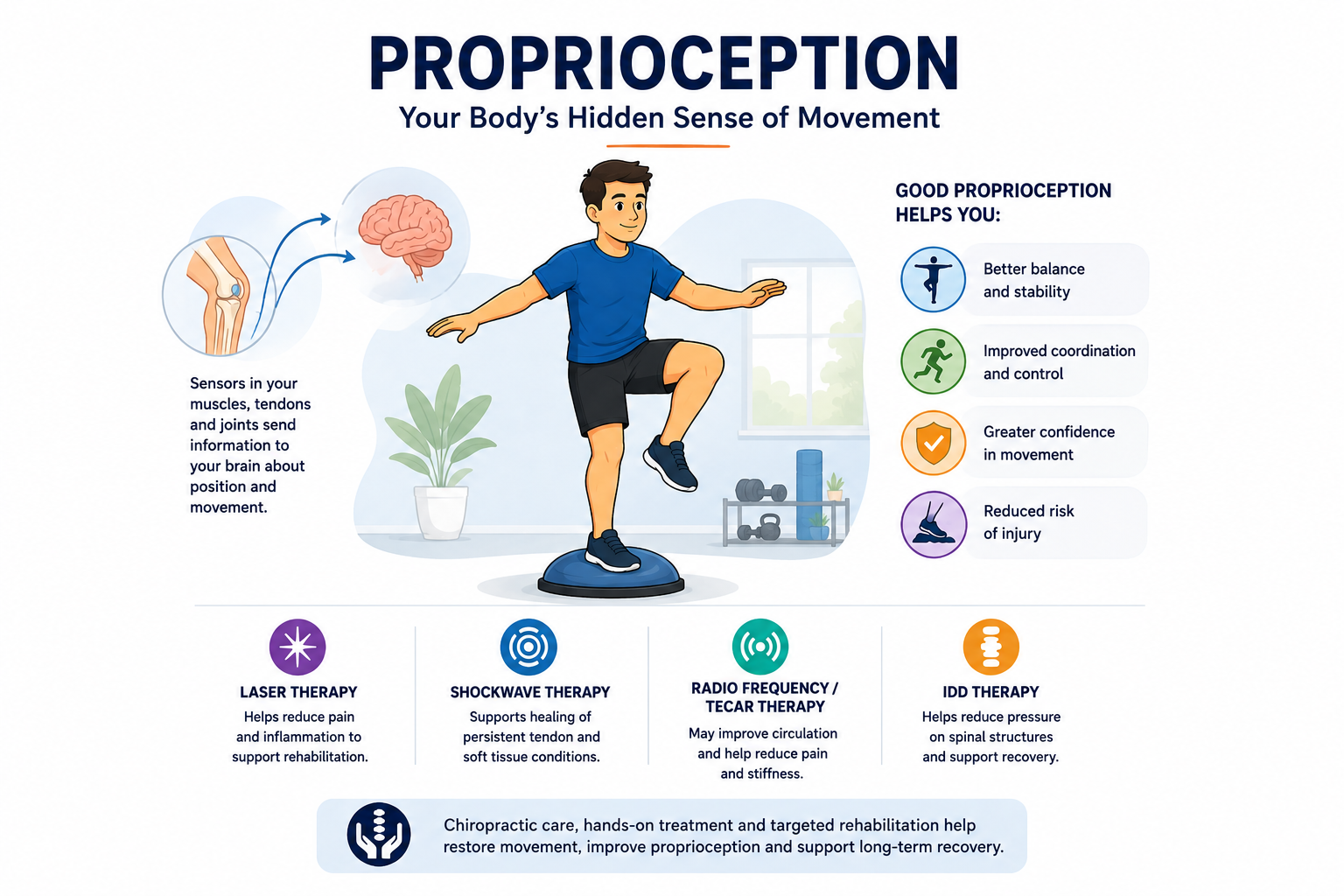
Proprioception: Your Body’s Hidden Sense of Movement
Most people are familiar with sight, hearing, touch, taste and smell — but your body relies on another important sense every time you stand, walk or move.
Proprioception is your body’s ability to recognise where your joints and limbs are positioned without having to look at them.
It plays an important role in balance, coordination, joint stability and controlled movement, particularly during exercise and everyday activities.
🧠 How Does Proprioception Work?
Special sensory receptors within your muscles, tendons and joints constantly send information to the nervous system about your body’s position and movement.
This allows your brain to make rapid adjustments without you consciously thinking about them.
For example, proprioception helps you:
- Walk without watching your feet
- Balance on one leg
- Adjust when stepping onto an uneven surface
- Control your joints during running or exercise
- React quickly if you stumble or lose balance
⚠️ What Happens When Proprioception Is Reduced?
Proprioception can become impaired following an injury, period of inactivity or problems affecting normal joint and muscle function.
This may contribute to:
- Poor balance or coordination
- Reduced joint stability
- Feeling less confident on an injured limb
- Changes in movement patterns
- Increased risk of recurring injury
An ankle sprain is a common example. Even after the initial pain has disappeared, proprioceptive control around the ankle may still be reduced — potentially making another sprain more likely.
✅ How Can Proprioception Be Improved?
Proprioception can be trained just like strength or mobility.
Rehabilitation may gradually introduce exercises such as:
- Single-leg balance exercises
- Unstable or changing surfaces
- Controlled strengthening movements
- Coordination and reaction exercises
- Sport or activity-specific movements
As these become easier, the exercises can be progressively made more challenging to improve the body’s ability to react and control movement.
👐 Where Does Chiropractic Care Fit In?
Joint stiffness, pain and altered movement can affect how comfortably and confidently the body moves.
Chiropractic treatment may be combined with joint mobilisation, soft-tissue treatment and targeted rehabilitation to improve movement and help restore normal function.
The rehabilitation side is particularly important — improving movement is only part of the process; the body also needs to relearn how to control that movement effectively.
⚡ Supporting the Rehabilitation Process
✨ Laser Therapy may be used to help manage pain and inflammation where these are limiting rehabilitation.
💥 Shockwave Therapy can support treatment of certain persistent tendon and soft-tissue conditions.
⚡ Radio Frequency / TECAR Therapy may help with pain, stiffness and circulation while supporting recovery.
These treatments don’t replace proprioceptive training, but they may help address symptoms or tissue problems that are preventing someone from progressing with rehabilitation.
💡 The Key Takeaway
Proprioception is something most of us never think about — until injury affects it.
Recovering from an injury isn’t simply about becoming pain-free. Restoring balance, coordination, strength and confidence in movement can be equally important for returning to normal activity and reducing the risk of future problems.