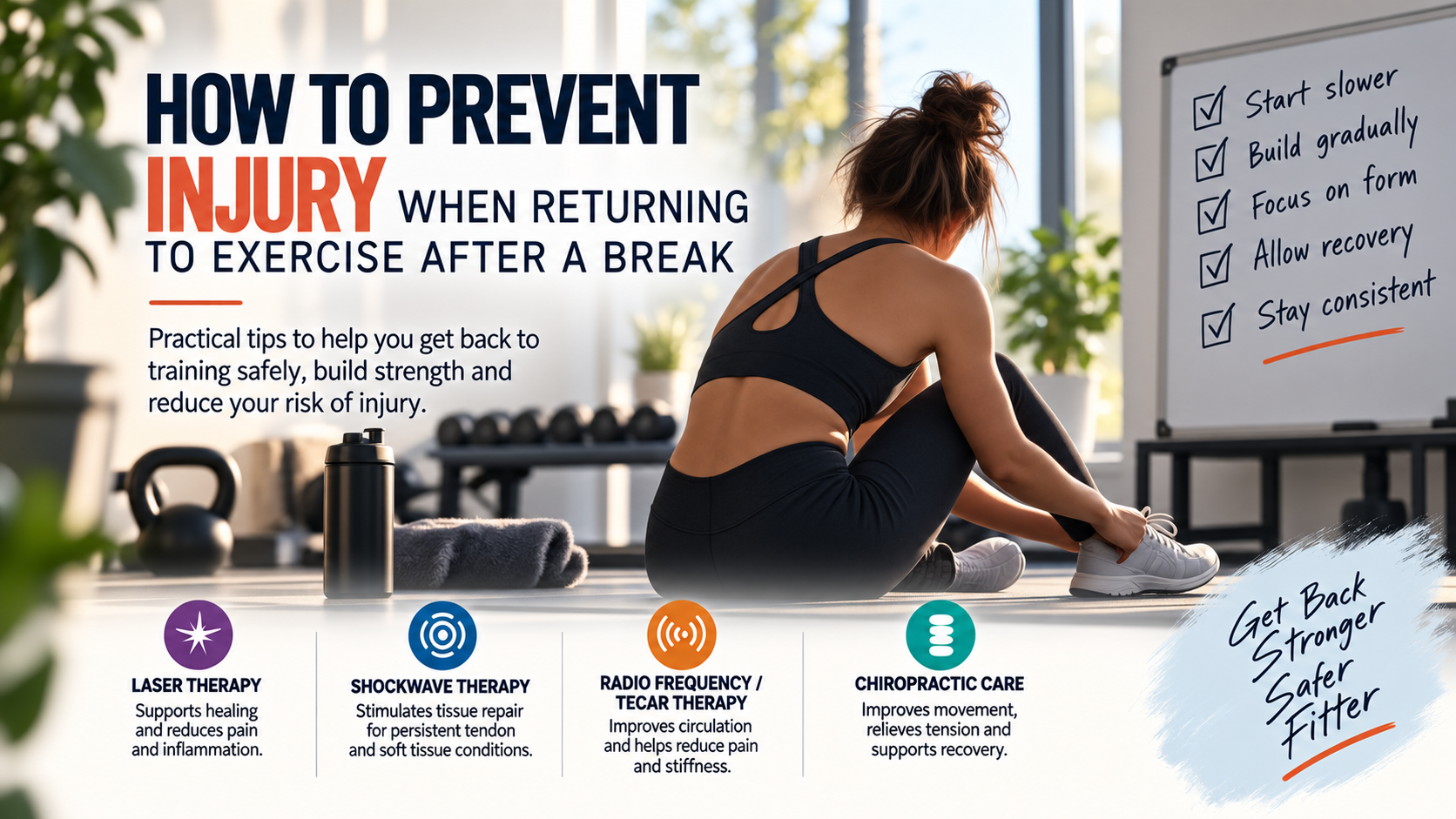
How to Prevent Injury When Returning to Exercise After a Break
Returning to exercise after a few weeks or months away can feel great — but one of the biggest mistakes is trying to restart exactly where you left off.
During a break, your strength, fitness and tolerance to exercise can reduce. Your motivation may return quickly, but your body’s ability to handle the same training load often takes a little longer.
Why Injuries Can Happen After a Break
Many return-to-exercise injuries aren’t caused by exercise itself, but by doing too much, too soon.
Common problems include:
– Returning immediately to previous weights or distances
– Training too frequently in the first few weeks
– Sudden increases in running or high-impact exercise
– Ignoring persistent pain or unusual soreness
– Not allowing enough recovery between sessions
Muscles, tendons and joints need time to readapt to regular loading, even if you have trained extensively in the past.
Start Below Where You Left Off
Your first few sessions should feel easier than you think they need to.
Reduce your weight, distance, intensity or overall training volume and gradually build these back up.
Rather than immediately returning to your previous 10 km run or heavy gym session, begin with a more manageable workload and monitor how your body responds over the following day or two.
A little patience at the beginning can prevent a much longer interruption caused by injury.
Rebuild Strength and Movement
Don’t focus only on getting your fitness back.
Strength, mobility, coordination and control may also need rebuilding after a period of reduced activity.
Include:
– Progressive resistance training
– Appropriate mobility work
– Controlled movements through comfortable ranges
– Balance and stability exercises where relevant
– A gradual return to sport-specific movements
The aim is to progressively prepare your body for the demands you eventually want it to tolerate.
Don’t Forget Recovery
More training isn’t always better training.
Sleep, nutrition and recovery days give your body time to adapt between sessions.
Some muscular soreness after returning to exercise is normal. However, persistent or worsening pain, swelling, significant loss of movement or symptoms that repeatedly return during exercise shouldn’t simply be ignored.
Adjusting your training early can sometimes prevent a minor problem becoming a longer-term setback.
How Chiropractic Care Can Help You Return to Exercise
If pain, stiffness or a previous injury is making you hesitant about returning to exercise, an assessment can help identify what may be limiting your movement and what your body is currently ready to tolerate.
Depending on the individual, chiropractic care may combine hands-on treatment with movement assessment, mobility work and targeted rehabilitation.
This can help to:
– Address painful or restricted movement
– Identify areas of weakness or reduced mobility
– Improve confidence when returning to activity
– Rebuild strength and movement gradually
– Guide progression back towards normal training or sport
The aim isn’t simply to get you feeling better for your next workout. It’s to help your body become strong enough and capable enough to tolerate exercise consistently again.
The Key Takeaway
After a break, your motivation may be ready before your body is.
Start slightly easier than you think you need to, gradually increase the demands placed on your body and give yourself enough time to recover between sessions.
You don’t need to rush back to your previous level. A controlled return now can help you train more consistently and reduce unnecessary setbacks later.
If pain or a previous injury is preventing you from returning to exercise confidently, Isis Chiropractic Centres can assess the problem and develop an individual treatment and rehabilitation approach to help you get moving again.