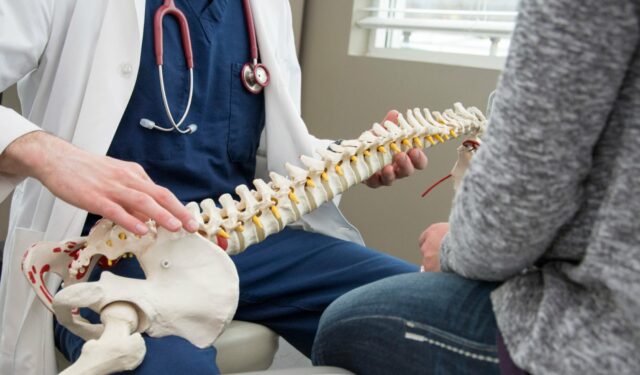
What Is a Spinal Disc?
Intervertebral discs sit between the vertebrae of the spine. Each disc has a softer central region surrounded by stronger outer layers of fibrous tissue.
The discs help distribute loads through the spine while allowing movement between the vertebrae.
Like other structures in the body, discs change with age. These changes are not necessarily a sign of damage or disease and do not always cause pain.
Looking for local assessment and treatment for a disc problem? Find out more about disc herniation treatment in Milton Keynes, disc herniation treatment in Northampton or disc herniation treatment in Aylesbury.
What Is a Disc Herniation?
A disc herniation occurs when material from within a disc extends through or beyond its outer layers.
You may also hear terms such as slipped disc, prolapsed disc, bulging disc or disc protrusion. These terms are sometimes used interchangeably by patients, although medically they can describe somewhat different findings.
Disc changes can develop gradually and are influenced by several factors. Sometimes symptoms start following lifting, bending or another activity; in other cases there is no obvious triggering event.
A disc herniation on an MRI is a finding – not automatically a diagnosis of what is causing your pain.
Disc bulges and herniations are also found on scans in people who have no pain. This means that a scan needs to be interpreted alongside your symptoms and clinical examination.
How Can a Disc Herniation Cause Pain?
Disc-related problems can present in different ways.
Some people primarily experience low-back pain. Others develop symptoms because disc material or associated inflammation affects a spinal nerve root.
This can produce sciatica, with pain travelling into the buttock or leg and sometimes numbness, tingling or muscle weakness.
Not all leg pain is sciatica, however. Pain can also be referred into the buttock or leg from structures in the lower back without a spinal nerve being affected.
This is why establishing the likely source of the symptoms matters before deciding on treatment.
Read more about Sciatica and Chiropractic Treatment →
Do Disc Herniations Always Need Treatment?
No. Disc abnormalities are frequently found in people who have no symptoms at all. Disc degeneration, bulging and protrusion become increasingly common with age and do not necessarily require treatment.
Even when a disc herniation is producing symptoms, surgery is not automatically necessary. Conservative management is usually considered first when there is no cauda equina syndrome, significant progressive neurological deficit or another condition requiring urgent specialist treatment.
Treatment should therefore be based on the person and their symptoms – not simply the appearance of an MRI scan.
How We Assess a Suspected Disc Problem
A thorough assessment is particularly important when symptoms include pain travelling into the leg, numbness, tingling or weakness.
At Isis Chiropractic Centres, assessment may include:
- How and when the symptoms began
- The location and pattern of pain
- Movement of the lumbar spine
- Muscle strength
- Sensation
- Reflexes
- Neurological examination
- Nerve-tension tests where appropriate
- Previous episodes and relevant medical history
We also look for symptoms or examination findings that might indicate that further investigation or referral is required.
Do I Need an MRI?
Not necessarily.
MRI can be extremely useful when the result is likely to change how a condition is managed, but routinely scanning everyone with back pain or sciatica is not recommended.
This is partly because abnormalities on MRI are common in people who have no symptoms. A scan result therefore needs to be interpreted alongside the patient’s symptoms and examination findings.
If your examination indicates that imaging or specialist assessment would be appropriate, we will explain why and discuss the next step.
Can Chiropractic Care Help With a Disc Problem?
Chiropractic care at Isis is not simply spinal manipulation.
Our approach is based on the individual patient’s diagnosis, symptoms, neurological findings and ability to move and function.
Depending on what we find, a programme of care may include:
- Advice and reassurance
- Guidance about activity
- Mobilisation or spinal manipulation where appropriate
- Soft-tissue treatment
- Specific exercises
- Progressive rehabilitation
- Strategies for returning to work, sport and normal activities
Other treatment options available at Isis may also be considered where clinically appropriate.
The purpose of treatment is not to “put a disc back in”. Treatment aims to reduce symptoms, improve movement and function and help the patient progressively return to normal activity.
This package-of-care approach is consistent with NICE guidance, which considers manual therapy – including spinal manipulation, mobilisation and soft-tissue techniques – for low-back pain with or without sciatica when used as part of a treatment package including exercise.
Is a Disc Herniation a Contraindication to Spinal Manipulation?
Not automatically.
The presence of a lumbar disc herniation does not, by itself, mean that spinal manipulation is inappropriate.
What matters is the clinical presentation of the individual patient.
Before considering manipulation, the chiropractor assesses the patient’s symptoms, neurological findings, severity and progression of the condition and any relevant imaging.
Spinal manipulation may therefore be one component of treatment for an appropriately selected patient with a disc problem. In other circumstances, mobilisation, exercise, rehabilitation or another approach may be more appropriate.
Published research does not support treating lumbar disc herniation as inherently unsafe for spinal manipulation. However, the evidence – particularly for precise estimates of serious adverse-event risk – has limitations, which is why appropriate assessment and patient selection are important.
The important question is not simply “Is there a disc herniation?” but “Which treatments are appropriate for this particular patient?”
Exercise and Rehabilitation
Exercise and rehabilitation are important parts of managing many disc-related problems.
Initially this may involve relatively simple movements and advice about maintaining activity. As symptoms improve, rehabilitation can progress towards mobility, strength, control and the activities that matter to the individual patient.
Prolonged rest is generally not the objective. Patients are usually encouraged to remain active and continue normal activities where possible.
At Isis, rehabilitation is therefore not something that necessarily starts after chiropractic treatment has finished. It can be part of the treatment from the beginning.
What About IDD Therapy?
For some patients with persistent disc-related symptoms, we may discuss Intervertebral Differential Dynamics (IDD) Therapy as an additional treatment option.
IDD Therapy is a computer-controlled form of spinal decompression. It is different from spinal manipulation and may be considered as part of a broader treatment and rehabilitation programme where appropriate.
Learn more about IDD Therapy →
Will a Disc Herniation Heal?
Symptoms from a lumbar disc herniation can improve considerably with conservative management, and many people do not require surgery.
Recovery varies. It depends on factors including the nature of the problem, neurological involvement, symptom severity, general health and individual circumstances.
The aim is therefore not to promise a particular recovery time but to monitor progress and modify the management plan appropriately.
When Might Surgery Be Considered?
Most people presenting with a lumbar disc herniation do not automatically need surgery.
Specialist surgical assessment may become appropriate when non-surgical treatment has not adequately improved pain or function and imaging findings correspond with the person’s sciatic symptoms.
Significant or progressive neurological problems require a different level of urgency and may require prompt specialist assessment.
When Should I Seek Urgent Medical Attention?
Go to A&E urgently if severe back or leg pain is accompanied by new:
- Difficulty controlling the bladder or bowel
- Changes in sexual function
- Numbness around the genitals, buttocks or saddle area
- Severe or rapidly progressing weakness affecting the legs
These symptoms can indicate cauda equina syndrome, which requires immediate medical assessment.
New or progressive significant muscle weakness should also be assessed promptly.
Disc Herniation and Slipped Disc Treatment Near You
If you have back pain or sciatica, or have been told that an MRI shows a disc bulge, protrusion or herniation, the first step is to establish whether the disc finding is actually relevant to your symptoms.
Our chiropractors will assess your condition, explain what we find and discuss the treatment, rehabilitation or further investigation options that may be appropriate.
Disc Herniation Treatment in Milton Keynes
Our Milton Keynes clinic provides assessment and treatment for disc-related back pain and sciatica, with on-site X-ray facilities, rehabilitation facilities and free parking. For some patients with persistent disc-related symptoms, IDD Therapy may also be considered as part of a broader treatment and rehabilitation programme.
Disc herniation treatment in Milton Keynes →
Disc Herniation Treatment in Northampton
Our Northampton clinic provides assessment and treatment for disc-related back pain and sciatica, with on-site X-ray facilities, rehabilitation facilities and free parking. Where appropriate, IDD Therapy may also be considered for some patients with persistent disc-related symptoms.
Disc herniation treatment in Northampton →
Disc Herniation Treatment in Aylesbury
Our Aylesbury clinic provides assessment and treatment for disc-related back pain and sciatica, with on-site X-ray facilities and free patient parking. Treatment is based on the individual assessment rather than simply the appearance of a scan.
Disc herniation treatment in Aylesbury →
Milton Keynes | Northampton | Aylesbury
Frequently Asked Questions
Can a chiropractor treat a herniated disc?
Chiropractic care may be appropriate for some people with disc-related back pain or sciatica. Care at Isis is not limited to manipulation and may include advice, manual therapy, exercise and rehabilitation. Treatment is selected according to the individual patient’s clinical findings.
Can you manipulate a herniated disc?
A disc herniation is not automatically a contraindication to spinal manipulation. Whether manipulation is appropriate depends on the patient’s symptoms, neurological examination and other clinical findings. Manipulation should therefore be selected for the individual rather than used routinely for every disc problem.
Can manipulation put a disc back into place?
No. A herniated disc is not simply a structure that can be pushed back into position. This is not an accurate explanation of how spinal manipulation works.
Does a disc bulge on MRI mean it is causing my pain?
No. Disc abnormalities are common in people without pain. MRI findings need to be interpreted alongside the person’s symptoms and clinical examination.
Do I need surgery for a slipped disc?
Not necessarily. Conservative management is generally considered first when there is no cauda equina syndrome or serious progressive neurological deficit. Surgery may be considered in selected patients when symptoms and function do not improve sufficiently and imaging findings correspond with the clinical problem.