Back Pain Treatment & Chiropractic Care
Back pain can have many causes. Learn how we assess back pain and use individualised treatment and rehabilitation to help improve movement and function.
Read more
Computer-controlled spinal decompression for selected patients with persistent spinal pain, sciatica and disc-related symptoms.
IDD Therapy (Intervertebral Differential Dynamics Therapy) is a computer-controlled form of spinal distraction used for selected patients with persistent back pain, neck pain and disc-related symptoms.
Unlike traditional forms of traction, IDD Therapy allows controlled distraction forces to be progressively applied using treatment parameters selected for the individual patient and the region of the spine being treated.
At Isis Chiropractic Centres, we do not recommend IDD Therapy simply because an MRI shows a disc bulge or herniation. We first assess your symptoms, neurological function and clinical findings to establish whether the disc finding is relevant and which treatment options may be appropriate.
When IDD Therapy is used, it can form part of a broader programme of care which may also include advice, exercise and rehabilitation.
Want to know more? Request a Callback
Or give us a call, to find out how we can help you with IDD Therapy for Back Pain, Neck Pain & Disc Problems.
Book an Appointment
Schedule an appointment for IDD Therapy for Back Pain, Neck Pain & Disc Problems tailored to your needs.
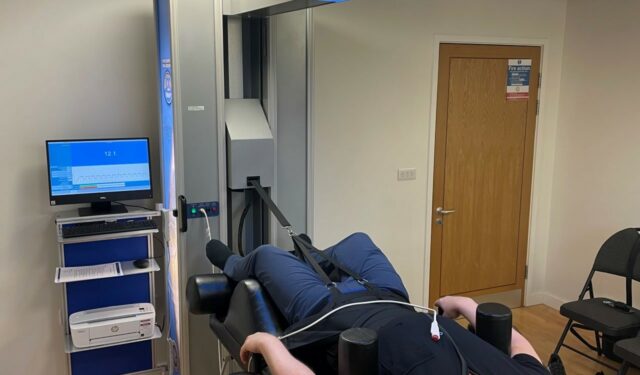
The short video below demonstrates the IDD Therapy equipment and shows how computer-controlled spinal distraction is delivered during a treatment session.
When IDD Therapy is used, it can form part of a broader programme of care which may also include advice, exercise and rehabilitation.
IDD Therapy stands for Intervertebral Differential Dynamics Therapy. It is a non-surgical, computer-controlled form of spinal distraction or decompression.
The patient lies on a specialised treatment table and is positioned using a harness system. The equipment then applies carefully controlled distraction forces according to a programmed treatment protocol.
The forces are gradually increased and released during the treatment session. The IDD system also allows treatment parameters to be adjusted according to the patient’s condition, response and the region of the spine being treated.
IDD Therapy is different from spinal manipulation. It does not involve a high-velocity manual thrust.
Spinal traction has existed in various forms for many years. IDD Therapy was developed as a more controlled approach to spinal distraction.
The IDD system allows the clinician to control factors including the amount of distraction force, the way that force is progressively applied and released, and the positioning used during treatment.
The SPINA system used for IDD Therapy also incorporates an oscillatory mobilisation component during the distraction phase of treatment.
These features distinguish the way IDD Therapy is delivered from older forms of static traction. However, IDD remains part of the broader family of mechanical spinal distraction and traction treatments.
At Isis Chiropractic Centres, IDD Therapy may be considered for selected patients with persistent spinal symptoms, particularly when previous conservative treatment has not produced sufficient improvement.
Depending on the individual clinical presentation, this may include people with:
Having one of these conditions does not automatically mean that IDD Therapy is appropriate.
We treat the patient rather than simply treating an MRI finding. The decision to recommend IDD depends on the patient’s symptoms, examination findings, neurological status, previous treatment and overall clinical picture.
IDD Therapy applies controlled distraction and mobilisation to the treated region of the spine.
During treatment, the mechanical forces acting across the spinal joints and intervertebral discs are temporarily altered. Several mechanisms have been proposed to explain why this may help some patients, including changes in mechanical loading, movement and muscle activity.
Changes in pressure within the intervertebral disc have also been proposed as one possible mechanism associated with spinal distraction.
However, it is important not to overstate what is known.
IDD Therapy should not be described as physically “putting a slipped disc back into place”, nor has it been established that IDD regenerates a damaged disc.
For us, the clinically important question is whether treatment helps improve the patient’s symptoms, movement and function.
During treatment you lie on the IDD treatment table and are comfortably positioned using a harness system.
The machine gradually applies and releases distraction forces according to your treatment programme. Treatment forces can be adjusted according to your condition, size, response and tolerance.
IDD Therapy does not involve injections or surgery and does not involve spinal manipulation.
Your response is monitored during the treatment programme and the approach can be modified where appropriate.
Research into spinal traction and decompression has produced mixed results, and it is important to distinguish research into mechanical traction generally from research specifically investigating IDD Therapy.
There is evidence suggesting that mechanical traction can improve pain and disability in some patients with lumbar disc herniation.
A 2022 systematic review and meta-analysis reported improvements in pain and disability from mechanical traction in patients with lumbar disc herniation compared with conventional physical therapy.
A larger systematic review and meta-analysis published in 2025 examined exercise, manipulation and traction for lumbar disc herniation. Traction produced favourable pooled results for pain and disability and had the largest pooled effect in the analysis, although the authors cautioned that this should not be interpreted as strong evidence that traction is superior to the other treatments.
However, there was considerable variation between the studies, including differences in patients, treatment protocols and follow-up periods. The authors therefore cautioned that the evidence is not yet sufficient to identify precisely which groups of patients are most likely to benefit.
Research specifically investigating IDD Therapy is more limited.
One randomised controlled trial involving patients with chronic low-back pain compared therapeutic IDD with sham IDD, with both groups also receiving a graded activity programme. The study did not demonstrate a significant additional benefit from therapeutic IDD.
Other published studies and clinical reports have described improvements following IDD Therapy, but much of this evidence is observational and therefore cannot establish effectiveness as reliably as well-designed randomised controlled trials.
Overall, the evidence suggests that mechanical traction may benefit some patients with lumbar disc herniation, while the evidence specifically for IDD Therapy remains limited and mixed.
Current NICE guidance for low-back pain and sciatica recommends against routinely offering traction.
IDD Therapy is a particular computer-controlled method of spinal distraction with treatment characteristics that differ from older forms of traction. However, it would not be appropriate to suggest that IDD is completely unrelated to traction or that the NICE recommendation can simply be disregarded.
At the same time, research has continued since the NICE recommendation was originally published, including more recent systematic reviews reporting favourable results for traction in selected patients with lumbar disc herniation.
This is one reason why we believe IDD Therapy should be considered selectively rather than routinely offered to everyone with back pain or a disc problem.
A disc herniation does not automatically require IDD Therapy, just as it does not automatically require spinal manipulation or surgery.
Disc abnormalities are common on MRI scans, including in people who have no pain. The first question is therefore whether the disc finding corresponds with the patient’s symptoms and clinical examination.
If a disc problem appears clinically relevant, treatment options may include advice, exercise and rehabilitation, appropriate manual therapy and, for selected patients, IDD Therapy.
Learn more about Disc Injuries & Chiropractic Treatment →
At Isis, we do not regard IDD Therapy as a stand-alone answer to persistent back pain or disc problems.
Reducing pain is only one part of successful treatment. Where appropriate, IDD Therapy can be combined with advice about activity and a progressive rehabilitation programme designed to improve movement, strength and confidence.
As symptoms improve, the emphasis can progressively move from passive treatment towards helping the patient return to normal activity, work, exercise or sport.
Our aim is not simply to treat your spine on a machine. It is to help you function better away from it.
IDD Therapy is normally delivered as a programme rather than as a single treatment.
A typical IDD programme may involve a series of treatments delivered over several weeks, with treatment forces progressively adjusted according to the patient’s response.
The number and frequency of treatments recommended at Isis will depend on your condition, how long you have had symptoms, your clinical findings and your response to treatment.
Your progress should therefore be reviewed during the programme rather than assuming in advance that every patient requires exactly the same number of treatments.
IDD Therapy is not appropriate for every patient.
Before recommending treatment, we assess your medical history, symptoms and examination findings and consider whether further investigation or referral is required.
IDD Therapy may be unsuitable, or require particular consideration, in circumstances such as:
Suitability is therefore assessed individually.
IDD Therapy should not delay appropriate investigation or specialist referral.
Symptoms such as significant or progressive muscle weakness require prompt clinical assessment.
Go to A&E urgently if back or leg pain is accompanied by new:
These symptoms can indicate cauda equina syndrome and require immediate medical assessment.
If you have persistent back pain, sciatica or have been told that an MRI shows a disc bulge, protrusion or herniation, the first step is to establish what is most likely to be causing your symptoms.
Our chiropractors will assess your condition, explain what we find and discuss the treatment, rehabilitation or further investigation options that may be appropriate.
If we believe IDD Therapy is a reasonable option, we will explain why, what the treatment involves and what you can realistically expect from a programme of care.
Milton Keynes | Northampton | Aylesbury
IDD Therapy is a computer-controlled form of mechanical spinal distraction and belongs to the broader family of traction and decompression treatments. The equipment and treatment protocols differ from traditional static traction, but it would be misleading to describe IDD as completely unrelated to traction.
No. A herniated disc should not be thought of simply as something that can be pushed or pulled back into position. The aim of treatment is to improve symptoms and function rather than physically “put a disc back”.
There are proposed mechanical and biological mechanisms associated with spinal distraction, but current clinical evidence does not establish that IDD Therapy regenerates or heals damaged discs. We therefore assess treatment primarily according to improvements in symptoms and function.
Research into mechanical traction for lumbar disc herniation has reported improvements in pain and disability in some studies. Evidence specifically investigating IDD Therapy is more limited and mixed. We therefore regard IDD as a treatment option for appropriately selected patients rather than a treatment that has been proven to work for everyone.
IDD Therapy uses gradually applied and released distraction forces and treatment is adjusted according to the patient’s response and tolerance. If treatment aggravates symptoms or is uncomfortable, the programme can be modified and the patient’s condition reassessed.