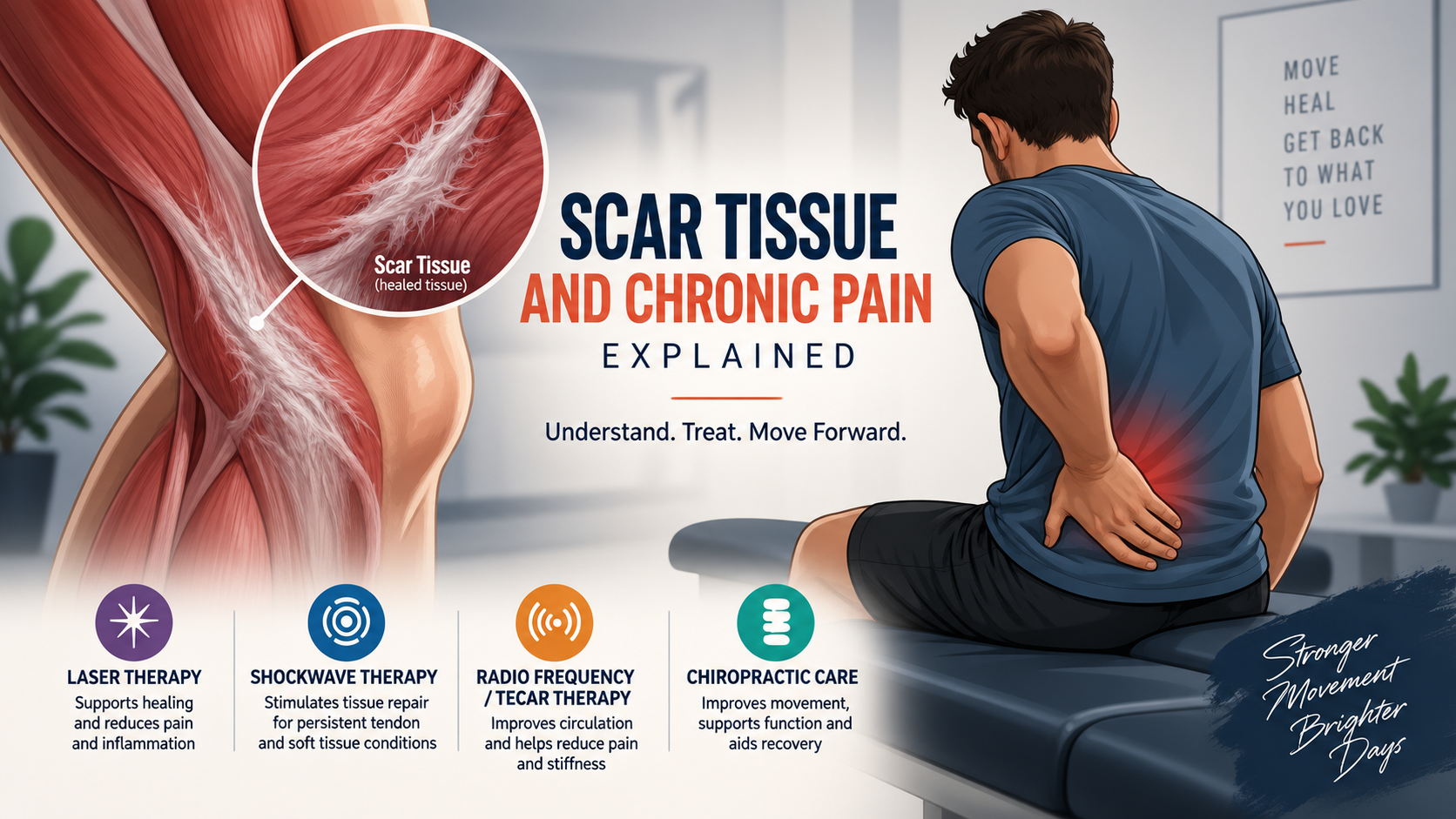
Scar Tissue and Chronic Pain Explained
Scar tissue is a normal part of the body’s healing process. When muscles, tendons, ligaments or other tissues are injured, the body produces new collagen to help repair the damaged area.
While this is essential for recovery, problems can sometimes develop when the healed area remains stiff, sensitive or unable to tolerate normal movement and load.
🩹 What Is Scar Tissue?
Following an injury or surgery, the body lays down collagen fibres to repair damaged tissue.
Early scar tissue is generally less organised than the original tissue. As recovery progresses, movement and appropriate loading help the repaired area remodel and adapt to the demands placed upon it.
Problems may arise when recovery is incomplete or the area remains sensitive, weak or restricted.
This can contribute to:
- Stiffness or reduced movement
- Tenderness around the injured area
- Reduced strength or flexibility
- Discomfort when stretching or exercising
- Difficulty returning to normal activities
⚠️ Does Scar Tissue Cause Chronic Pain?
Scar tissue itself isn’t automatically painful.
Persistent pain following an injury can involve several factors, including changes in tissue mobility, weakness, joint stiffness, altered movement and increased sensitivity of the nervous system.
This is why simply waiting for an injury to “fully heal” isn’t always enough. The repaired tissue needs to gradually regain its ability to move, strengthen and tolerate load.
✅ How Can Scar Tissue and Persistent Symptoms Be Managed?
Treatment depends on the original injury and the reason symptoms are continuing.
A rehabilitation programme may include:
- Progressive strengthening
- Mobility and flexibility exercises
- Gradual loading of the affected tissue
- Manual and soft-tissue techniques
- Returning gradually to normal or sporting activity
The aim isn’t necessarily to “break down” scar tissue, but to improve movement, function and the capacity of the healed area.
👐 How Chiropractic Treatment Can Help
Following an injury, stiffness and altered movement can sometimes develop in surrounding joints and muscles.
Chiropractic treatment may incorporate joint mobilisation, manual therapy and soft-tissue techniques alongside rehabilitation to improve movement and help the area return to normal function.
Addressing the surrounding joints and muscles can be particularly useful when compensatory movement patterns have developed because of a previous injury.
⚡ Advanced Treatments to Support Recovery
Where appropriate, additional treatments available at Isis Chiropractic Centres may complement rehabilitation.
✨ Laser Therapy may help manage pain and inflammation while supporting tissue recovery.
These treatments are most effective when used as part of a wider plan rather than as a replacement for appropriate movement and rehabilitation.
💡 The Key Takeaway
Scar tissue is a normal and necessary part of healing, and its presence doesn’t automatically mean it is responsible for ongoing pain.
When symptoms persist after an injury, the important question is why the area hasn’t returned to normal function.
Improving mobility, progressively rebuilding strength and restoring confidence in movement can help the previously injured area adapt and become more capable again.
At Isis Chiropractic Centres, treatment and rehabilitation can be tailored to identify what may be contributing to persistent symptoms and help you move towards a more complete recovery.