Lumbar Spinal Stenosis
Lumbar spinal stenosis can cause leg pain, numbness, heaviness and reduced walking ability. Learn about assessment, multimodal treatment and rehabilitation.
Read more
Good posture plays an important role in health and performance. But what exactly is good posture? And why does it matter? Understanding posture—and how chiropractic treatment can support it—is key to maintaining overall well-being.
Posture is how you hold your body during any activity—not just sitting or standing. It includes how you move, lift, bend, and perform daily tasks.
When you maintain good posture, your body works more efficiently. You use less energy and lower your risk of injury. That’s because you reduce strain on your joints and muscles. Whether you’re doing manual labour, gardening, or playing sports, good posture makes tasks easier and safer.
Athletes at all levels benefit from proper posture. Using your body’s natural levers correctly gives you better mechanical advantage. You move more efficiently, produce more power, and increase speed—all while lowering the risk of strain or injury.
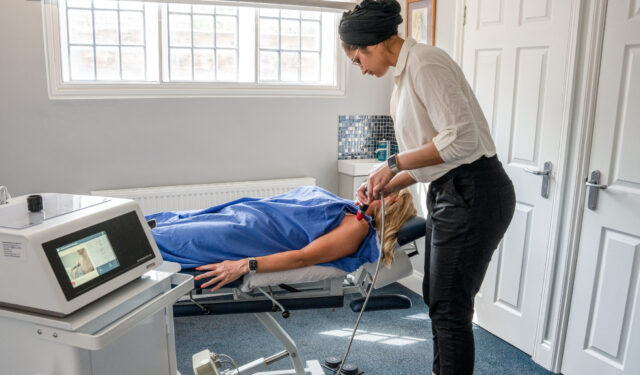
Posture and chiropractic treatment go hand in hand. Chiropractic care helps correct poor posture by addressing spinal misalignments, easing muscle tension, and restoring balance in the body. Regular chiropractic treatment supports healthy posture, especially if you spend long hours sitting, standing, or doing repetitive tasks.
In short, good posture and chiropractic treatment together improve performance, function, and long-term health.
Want to know more? Request a Callback
Or give us a call, to find out how we can help you with The Importance of Posture and How Chiropractic Can Help.
Book an Appointment
Schedule an appointment for The Importance of Posture and How Chiropractic Can Help tailored to your needs.
Having the ‘wrong’ posture can put your muscles, ligaments and joints under undue pressure, which can lead to pain and fatigue.
Let’s look at standing first. You should stand with your tummy pulled in slightly, chest out, shoulders back and chin slightly tucked in, with the weight evenly distributed between both feet.
If you look side-on, you should be able to draw a plumb line through the opening of your ear, the middle of the neck, middle of the lumbar spine, hip joint, knee and through the lump on the side of your ankle (lateral malleolus), the line should intersect all these points.
When you sit you should hold your upper body upright, maintain a slight arch in your lower back, shoulders back, chest out and neck upright with your chin slightly tucked in, planting both feet on the floor and not crossing your legs.
For example, for other activities such as golf, the spine should be close to straight looking from the side, not c- or s-shaped. Every activity has an optimal posture.
Two well known postural syndromes are the, so called, Upper Crossed Syndrome and Lower Crossed Syndrome. They relate to a specific type of muscle imbalance and should be dealt with in a specific way.
It normally develops as we grow up. Look at babies, as soon as they are able to sit and stand by themselves, they tend to have great posture.
By the time we are teenagers we have adopted a different posture, often slumped. But that is not true for everyone. Children who do gymnastics and classical dancing often have fantastic posture, because they are constantly told to hold themselves in a certain way. So, bad posture can be habitual, but let’s not forget our emotions. If we are ‘down’ or mentally tired, we tend to adopt a different, slumped, posture too.
Other important reasons for having poor posture include, having:
There are a few simple tests you can do which will help you find out what the cause of your bad posture is.
If you look at the 4 points above, whichever category you fall into, the direct recommendation for you would be:
If point 1 and 2 are true for you, then you will improve by holding that ‘good’ posture more often until you are able to do it all day or by doing specific postural exercises to strengthen your muscles. A chiropractor can help you with this.
If you fall into category 3, you need help. It would suggest you might need chiropractic treatment to help you, combined with an exercise programme. Contact a chiropractor and have a proper evaluation and have the underlying problem dealt with.
If you fall into category 4, you should try to adopt your ‘good’ posture immediately and continue. If you feel unable to do it for any length of time, you might need chiropractic treatment to help you.
Your posture is very important, but posture is not the answer to all problems. Don’t expect that because you sit correctly at work in a good chair, all your problems will be solved. The human body needs exercise to function. Poor core muscle control and endurance of the postural muscles, is going to make you more likely to get injured. Your muscles will protect your joints and ligaments, and exercise is the only thing that is going to help to improve your muscle control and endurance.
Here at the Isis Chiropractic Centres we include rehabilitation and self-help exercise in our treatment programmes.
Remember to tell your family and children about their posture. The younger you are when you start, the easier the change will be and you are likely to prevent problems in the future. If you have any questions or concerns about your posture, please ask us!
Lumbar spinal stenosis can cause leg pain, numbness, heaviness and reduced walking ability. Learn about assessment, multimodal treatment and rehabilitation.

Back pain can affect you at almost any age, but the factors contributing to it can change throughout your life. From training loads and long hours sitting in your 20s, to increasing work and family demands in your 40s, and changes in strength and mobility later in life — understanding what may be contributing to your
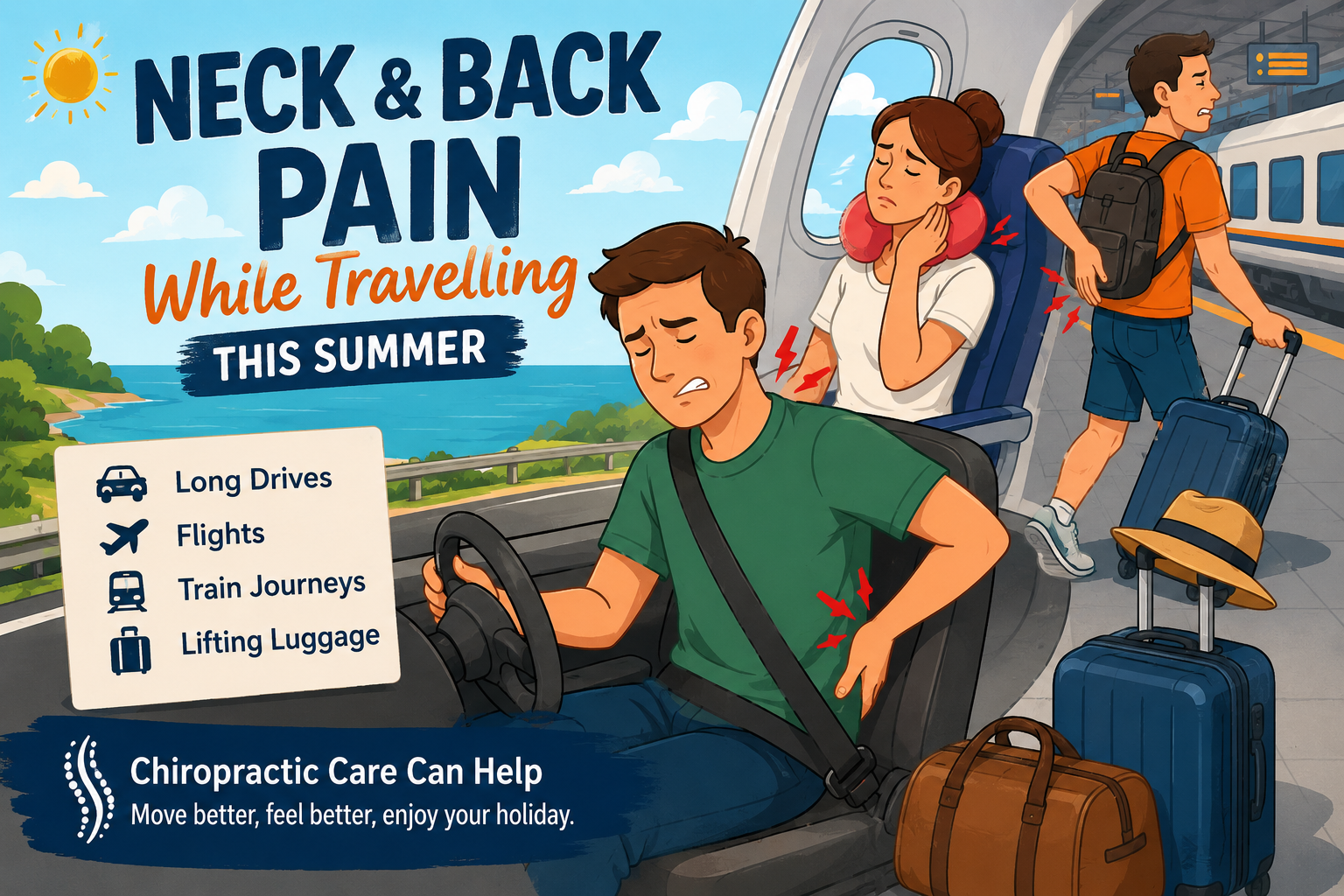
Summer holidays are something we all look forward to. Whether you’re heading abroad, taking a road trip, or travelling around the UK, long periods of sitting can take their toll on your body. It’s common for people to return from holiday with neck pain, lower back pain, stiff shoulders, headaches, or even sciatica. The good
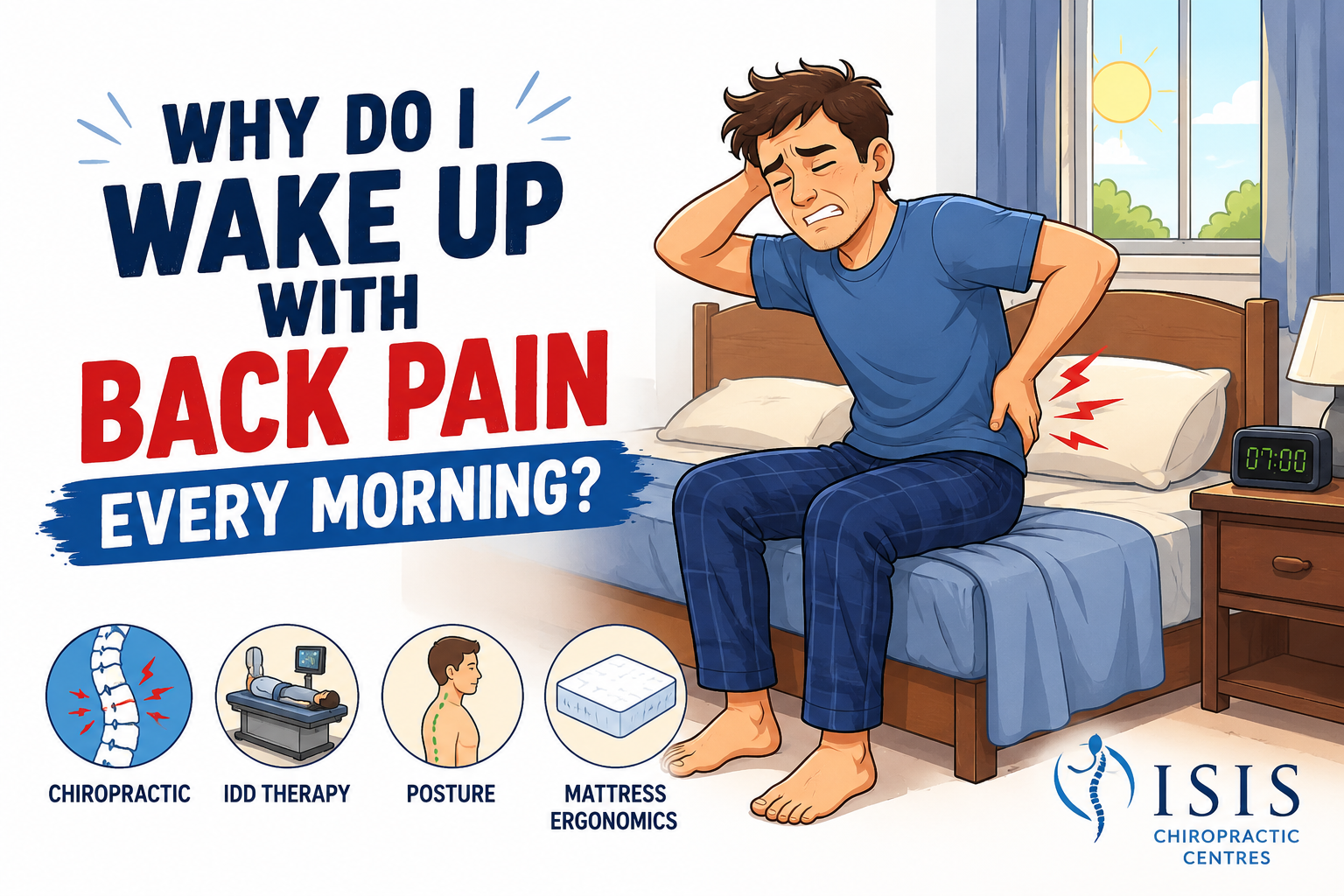
Waking up with back pain can be incredibly frustrating. You go to bed hoping your body will recover overnight, only to wake up feeling stiff, sore, or struggling to stand up straight. Morning back pain isn’t something you should simply accept as part of getting older. In many cases, it’s a sign that something is