Spinal Biomechanics and Chiropractic Treatment.
Chiropractic treatment – How does the spine work?
We have made this explanation simple on purpose. This is to explain the concept first. We apologise if some of you find it too simplistic, but rest assure, for you who want to get into the details of spinal mechanics and neurophysiology we will add more information soon.
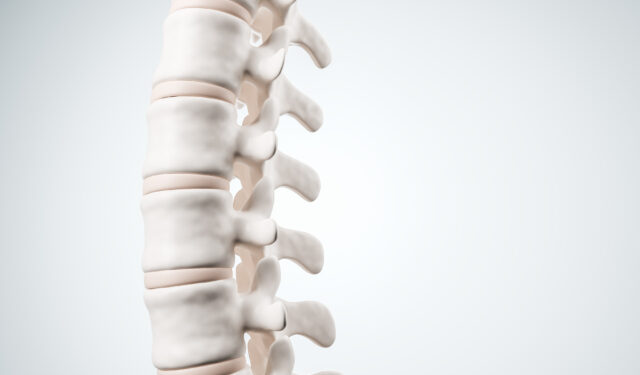
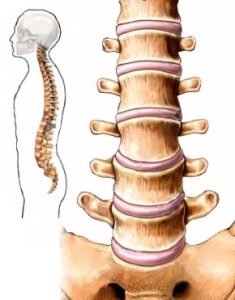
The spine is a long chain of 24 segments or vertebrae. Each segment has a limit of how far it can move safely. If it moves further than normal you get an injury and pain.
The individual vertebrae in the lower back have the capacity to move 2-5 degrees in rotation individually, which is not much. All together they provide enough movement to allow us to perform most things.
So why do we sometimes hurt ourselves doing trivial things such as reaching over the desk to pick up a paper?
Most of us have had injuries in the past, injuries during childhood, learning to walk or falls on the playground. The most common types of injuries are from normal daily activities, although some of us have been unfortunate to be involved in more serious injuries.
When you injure a muscle or ligament it heals with scar tissue, which is more rigid than the normal ligament. Hence, the movement at that segment is reduced and gradually over time the segments above and below start to move more to compensate and therefore become more ‘unstable’ and prone to injury.
This is why it is not advisable to do general twisting exercises or hyperextension exercises if you have a back problem. Does the McKenzie exercises aggravate your problem? Then stop now!
When you do general mobility exercises, the most flexible part will move the most and the stiff part of your spine will only move slightly, if at all, before you feel pain from the flexible part (that you just sprained).
There is no evidence to show that improving your general spinal movement will reduce your back pain, or neck pain. Chiropractic manipulation is very specific and precise. We can select exactly which vertebrae to move – that is why chiropractic is so effective.
What about the muscles?
The muscles of the back are very important because they provide active stability for the spine. That is why they go into spasm when we sustain an injury and are in pain.
We have active control over most muscles in the body but not of the deeper back musculature. Why not?
We have 24 vertebrae with two joints at each level four levels of muscles and several bundles of muscles attaching to each of the vertebrae – it would just be impossible! Walking and chewing gum at the same time would be impossible.
Fortunately, the subconscious part of our motor cortex (part of the brain) has learnt to do this without us having to think about it.
The deeper back musculature reacts solely on signals from the nerves sensing movement of the vertebral joints and ligaments and is therefore perfectly placed to protect the spine.
When things go wrong
Research has shown that after an injury the deep spinal muscles atrophy (waste away) and do not recover spontaneously just because the injury heal and the pain goes away. That will leave you more vulnerable to further injury. This is why rehabilitation exercise is an essential part of chiropractic treatment.
The back musculature provide two 3rds of the stability for the spine and the stomach only one 3rd. This is important to remember when you do your core stability training.
Back to Chiropractic and Exercise or go to Early Exercises to Help You Get Out of Bed.